• Work
  • About
Menu

Aonghas Crowe

  • Work
  • About
DSC04547.jpg
February IMG_3294.jpg

How to say February in Japanese

February 20, 2019

 It's February again which makes me wonder if there are any songs dedicated to the coldest month of the year. I can't think of any off the top of my head.

 This time last year an honest to god blizzard hit Fukuoka which was a lot of fun. I cancelled my class at the uni and took my sons out to Dazaifu which tends to get two to four times as much snow as we do in the city. Keep it in mind, the next time the area is hit with a snow storm.

Anyways, February, like the other months is known by a number of names in Japanese. Nigatsu (二月, "Second Month") is the most common. Kisaragi, also pronounced Jōgetsu (如月, ") is the old name for the month according to the lunar calendar, or inreki (陰暦, literally "cloudy/shadow + calendar"). The second month was also called 如月 in China, but apparently there is no connection to the kisaragi of Japan. 

There are some theories for the origin of the name. One is that in the old lunar calendar, kisaragiwas still cold--hey, it's still cold today--and people were encouraged to wear extra layers during the month. Kisaragi can also be written 衣更着, which means to put on (着) even more (更に) clothing (衣).

Another theory is that plants and trees (草木, kusagi) put forth new buds (芽が張り出す, mi-o haridasu) during the month, so the month may have been known as kusakihariduki, which when abreviated became kisaragi.

Reigetsu (麗月, "beautiful month") is another name for the second month because everything sparkles beautifully.

Umemizuki (梅見月, "plum blossom viewing month")

Hatsuhanatsuki (初花月, "first flower month")

Yukigeduki (雪消月, "snow disappears month")

Tangetsu (短月, "short month") due to the number of days in the month

In Winter in Japan, Life in Japan, Life in Fukuoka Tags How to say February in Japanese, Traditional Names for February, Dazaifu City, Dazaifu Tenmangu, Snow, Winter in Fukuoka
Comment
The magazine Keiko to Manabu, a subsidiary of Recruit, publishes an annual survey on extracurricular activities.

The magazine Keiko to Manabu, a subsidiary of Recruit, publishes an annual survey on extracurricular activities.

After School Activities in Japan

January 22, 2019

I have been trying to put a piece together on extracurricular activities in Japan with comparison to the situation in the States. There are loads of stats on naraigoto (習い事, after school lessons) here, but much less information concerning extracurricular lessons and activities in America. The Census Bureau claimed that 6 out of 10 kids in the US participated in some kind of extracurricular activity, but didn’t give much detail as to what kind or how often. One interesting nugget in the report was that only 8% of children in America were taking part in all three activities (i.e. sports, clubs, and lessons) at the same time. Children referred to those in grades K-12.

As for our family, my second-grade son does karate 2-4 times a week, soccer 2-3 times, soroban (abacus) once a week, and English once a week with his friends from kindergarten. He has mini English lessons with me a few times a week in addition to the lesson with his friends. During school breaks, we enroll him in swim lessons. For half of last year, he was in a shōgi (Japanese chess) class a few times a month. His 6-year-old brother has a similar schedule, minus the shōgi, and soccer is only once a week. In the winter months, I take the boys ice skating every other week.

Living downtown as we do, almost all of the lessons are a short walk away.

When my elder son was in his infancy, I had ideas about what lessons I would have him take—English, of course, but also calligraphy, classic guitar, and so on. None of that happened, except for the English.

His first activity was Play School. A bit expensive, but highly recommended. Shortly after he entered elementary school, though, he grew tired of it. Karate became the focus. At first it was only 1-2 times a week, but after getting his arse whooped in a tournament, he told his mother that he wanted to become stronger, so she started taking him to the main dōjō. Soccer was started as a way to maintain the friendships with his kindergarten friends but last year he changed teams, again in order to be a better player. Soccer is his passion at the moment and he doesn’t mind going to every practice. He insists even though he is exhausted afterwards.

The other day, I was walking past the Eishinkan Juku (cram school) just as the kids were getting out. It was Saturday evening and they kids looked as if the life had been sucked right out of them.

Cram schools like Eishinkan offer tests free to the public as a way to, one, check the level of the eggheads who study at their school with that of non-juku kids, and, two, to scare parents whose kids don’t go into following the herd and sending their own children as well. It’s a funny business.

We had our boy take the test a few weeks ago are now waiting the results. Ideally we would like to avoid jukus as long as possible, but I wonder how feasible it is. At the moment only a handful of his second grade classmates go, but by fifth grade apparently it’s the reverse. Even kids who are not going to take a private junior high school’s entrance exam go to juku which always has me scratching my head.

The Keiko to Manabu report had some interesting stats on narai goto in Japan.

graph_1121_01.png

44% of kids surveyed engaged in one extracurricular activity. 34% two part in two. 16% had three. 5%, like our sons, had four.

d25184-96-224977-3.jpg

40.8% of kids had swim lessons

27.7% had English lessons

20.3% Piano

14.1% Calligraphy

13.5% Cram School

12.8% Gymnastics

8.6% Soccer

7.1% Soroban/Abacus

5.1% Other Sports

4.3% Dance

4.3% Karate

In Life in Japan, Raising Kids in Japan Tags Naraigoto, Extra-curricular Activities, Afterschool Activities
Comment
Dazaifu Tenmangu (太宰府天満宮) is Fukuoka's most famous shrine.

Dazaifu Tenmangu (太宰府天満宮) is Fukuoka's most famous shrine.

Sansha Mairi

January 17, 2019

If you live in only one region of Japan for an extended time as I have, it’s easy to make the mistake of assuming that what is true in the town you reside in is also true throughout the rest of the country.

I first recognized this many, many years ago when I kept getting tripped up by the local dialect, known as Hakata-ben (博多弁). I’ve written about this elsewhere, but what I’m getting at here here is not my failure to understand what someone is saying because he is speaking the local dialect, but rather people not understand what I am saying because I have unwittingly used the dialect thinking that what I was speaking standard Japanese.

Take the Japanese word koi (濃い), which can mean deep, heavy, dark or thick—such as in koi aka (濃い赤), “deep red”; koi sūpu (濃いスープ) “thick soup”; ~ wa ajitsuke ga koi (〜は味付けが濃い) “. . . is strongly seasoned”; or even chi-wa mizu-yorimo koi (血は水よりも濃い) “Blood is thicker than water.” For the first ten years of my life here in Fukuoka, I thought koi was pronounced koyui. (Try looking it up in a Japanese-English dictionary.) If you go to Tõkyõ and ask a bartender to make you a stiff drink, saying “make it koyui”, he’ll probably give you a funny look.[1]

Traditional foods, too, can vary from region to region in Japan, so much so that a simple dish like o-zōni—a soup eaten during New Year’s—can contain radically different ingredients and yet still be called o-zōni.

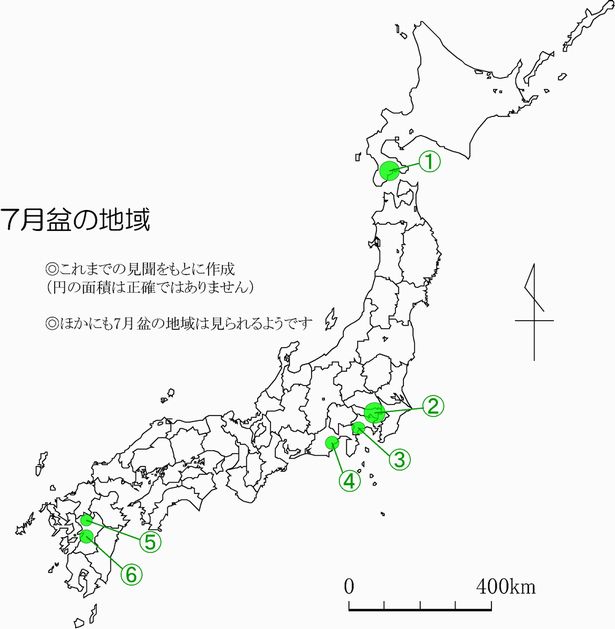
Customs, as I have mentioned before, also differ from prefecture to prefecture. The Bon Festival of the Dead, for example, can, depending on the region, be held as early as July 15th (in Shizuoka, for example) or in other parts on August 15th. Some regions, such as Okinawa, observe what is known as Kyū Bon (旧盆) which falls on the 15th day of the seventh lunar month. In 2019, Kyū Bon and “regular Bon” will take place at the same time, namely from the 13th to the 15th of August. Living all this time in Kyūshū, I used to assume that all Japanese celebrated the Bon in the middle of August and would pester everyone with the question: “Why isn’t this a national holiday like New Year’s?”

Stop pushing’!

Stop pushing’!

Now only a few years ago, it finally dawned on me that something I had taken for two decades to be a widely-observed custom was actually a very local one: sansha mairi (三社参り).

In Japan, many people (and I would venture most) visit a Shintō shrine during the first few days of the new year, a custom known as hatsumōdé (初詣), to pray or make wishes. At the shrines, they buy good luck charms called o-mamori (お守り), drink a special kind of saké, and buy written oracles known as o-mikuji (おみくじ). It’s primarily in Fukuoka, though, that people visit (o-mairi, お参り) three shrines (三社) rather than one.

Live and learn.

God? You up there? Do you hear me, God?

God? You up there? Do you hear me, God?

In Life in Fukuoka, Life in Japan, Japanese Customs, Japanese Language Tags Sansha Mairi, 三社まり, Hatsumode, 初詣, New Year's in Japan, New Year's in Fukuoka, Hakata Dialect, 博多弁
Comment
IMG_0360.jpg

So When is O-Shogatsu Over Anyways?

January 16, 2019

This is a piece I wrote for GaijinPot last year.

My wife took down the shime kazari the other day.

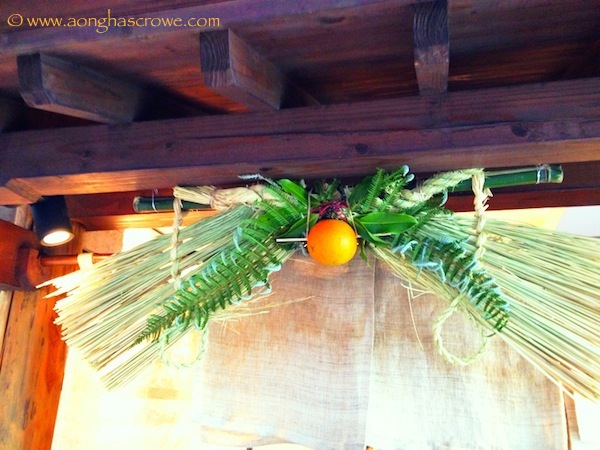
Shime kazari are the decorations you find hanging on front doors and gates at o-Shōgatsu (お正月, or the Japanese New Year). Traditionally made with twisted rice straw, they are often festooned with a daidai (bitter orange), fern fronds and gohei or shide (zigzag strips of white paper), the ornaments serve to welcome Toshigami-sama, the Shintō deity who brings a bountiful harvest and blessings for the new year.

Modern designs, like ours (above and below), take great liberties with more traditional decorations, adding generous loops of red-and-white  cords of twisted paper, known as mizuhiki, pine branches, colorful Japanese washi paper, auspicious doodads and occasionally fresh flowers.

I asked my wife what she was doing.

“Shōgatsu is over… ”

“Says who?”

“My parents already took down their shime kazari.”

“So? I paid ¥4,000 for that. Put it back. Please!”

“But… ”

IMG_3156.jpg

There’s quite a bit of debate about when you should take your New Year’s decorations down. Regional variations have something to do with it — why, even the design of the shime kazari themselves can vary greatly from region to region — but so do different interpretations of when o-Shōgatsu is officially concluded.

I guess you could say a similar discussion exists in the West concerning when Christmas trees should be tossed out. Is it the Feast of the Epiphany, which falls on Jan. 6 (hence the 12 Days of Christmas)? Or should the tree and other holiday decorations remain until Candlemas, which falls on Feb. 2, i.e. 40 days after the nativity of Jesus? Thanks to Christmas tree recycling drives hosted by the Boy Scouts in early January, in America at least, trees are now being ground up into mulch before they can become a fire hazard.

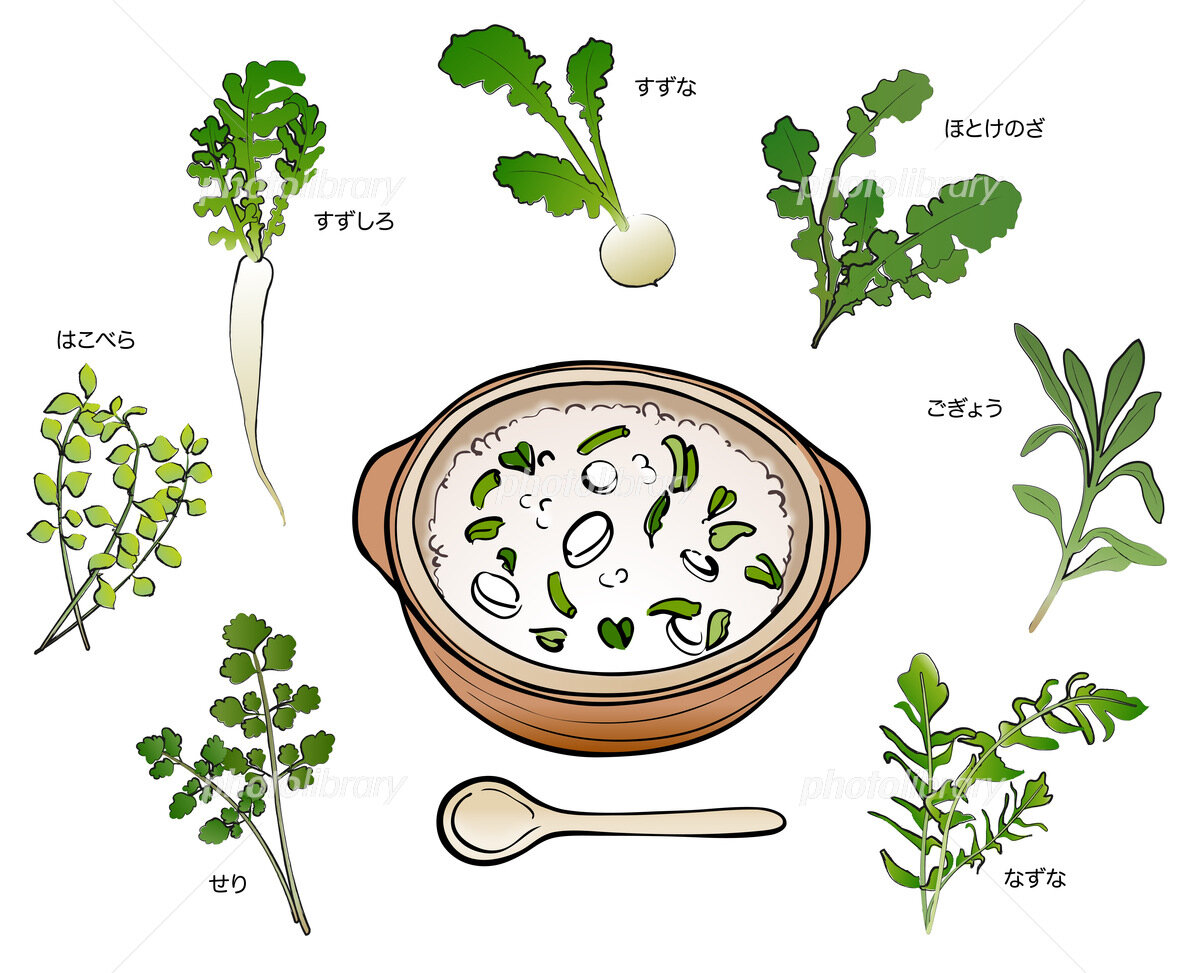
As for the last day of o-Shōgatsu, many assert that it is Jan. 7. This day is widely considered to be the final day of matsunouchi, the week-long period starting with New Year’s Day during which the kadomatsu (New Year’s “gate” pine) and other decorations are displayed. New Year’s greeting cards, known as nengajō, should be received within the first week of the year. The seventh is also the day Japanese eat nanakusa gayu, a dishearteningly bland rice porridge dish made with seven different herbs. It was for these reasons, I suspect, that my wife’s mother and many others had already taken their own decorations down.

But, I still wasn’t sold on the idea.

During a quick walk around my neighborhood, I noticed several shops were still displaying their shime kazari. Perhaps because it was Seijin-no-hi, or Coming-of-Age Day, a national holiday that serves as a psychological bookend to New Year’s.

Whatever the shops’ motivations, some believe that it’s quite alright to keep the decorations up until Jan. 15, a date known as Ko-Shōgatsu (小正月, Little New Year), as was the custom up until the Edo Period (1603-1868). The first week of the new year was called Ō-Shōgatsu (大正月, lit. “Big New Year,” in this instance) while the rest of the month was considered just regular “Shōgatsu.”

Rice porridge with seven herbs and salt.

Rice porridge with seven herbs and salt.

Ko-Shōgatsu is known by other names, too, such as Niban Shōgatsu (Second New Year’s), Onna Shōgatsu (女正月, Woman’s New Year) and so on. Before Japan adopted the Gregorian solar calendar, the 15th was the day on which the full moon appeared. As far back as the Heian period (794-1185), it was customary to eat rice porridge made with sweet, red azuki beans. A similar dish called o-shiruko (sweet red-bean soup), made with azuki beans and half-melted globs of mochi (sticky rice cake) is traditionally eaten around the 11th, the day kagami (mirror-shaped) mochi decorations are broken. Today, at shrines throughout Japan, you can find hi-matsuri (火祭り, fire festivals), known as sagicho or dondoyaki (burning of New Year’s gate and other decorations), held on the 15th when kadomatsu, shime kazari and the previous year’s talismans are set alight in a bonfire.

IMG_8782.jpg
IMG_8795.jpg

Despite that, others argue that it’s acceptable for New Year’s decorations to remain until Hatsuka (20th day of the month) Shōgatsu, which falls, not surprisingly, on the 20th of January. In the Kansai area, the head and bones of the buri (Japanese amberjack) are cooked with sake kasu (lees), vegetables and soy beans. Because of this, the day is also called Honé (bone) Shōgatsu.

My wife, following her mother’s example, had been deferring to tradition. I countered with the argument that if we were really going to stick to good ol’ “tradition,” we would have to keep the shime kazari up until March 2, which — in accordance with the Chinese lunar calendar — is actually Jan. 15.

“Let’s keep it up until Hatsuka Shōgatsu, then,” my wife suggested.

“The 15th will be fine,” I said. “We don’t want to get carried away.”

In Japanese Customs, Life in Japan Tags New Year's in Japan, o-Shogatsu, Toshigami, Shimekazari, Kadomatsu, Dontoyaki, Ko-Shogatsu, Kagami Mochi
IMG_4856.JPG

Kagami Mochi

December 31, 2018

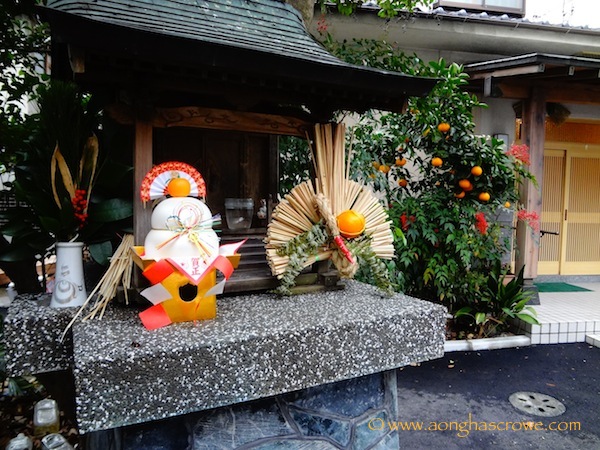
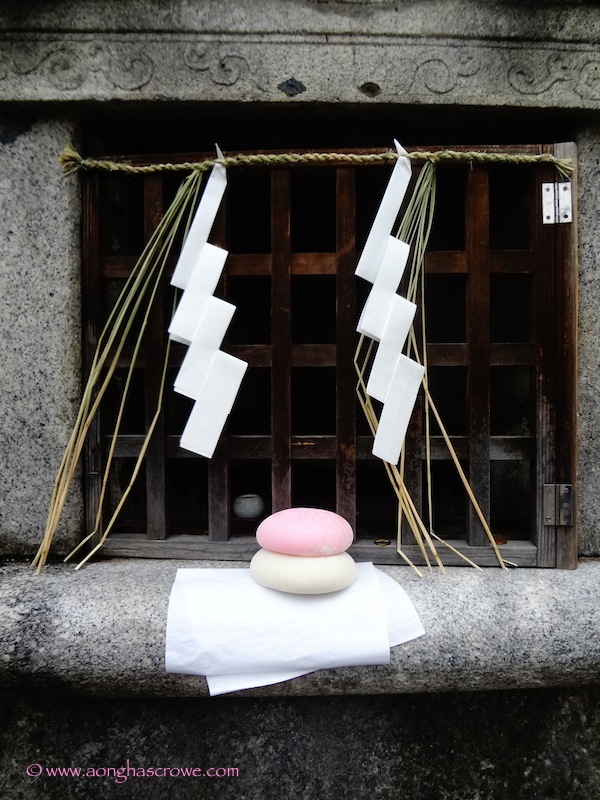
Kagami mochi (鏡餅, literally mirror rice cake) is a traditional Japanese New Year decoration, which consists of two round mochi (rice cakes), the smaller placed atop the larger, and a Japanese bitter orange, known as a daidai, with an attached leaf on top. It may also have a sheet of konbu and a skewer of dried persimmons under the mochi.

It often sits on a stand called a sanpō (三宝, see photo below) over a sheet called a shihōbeni (四方紅), which is supposed to ward off fires from the house for the following year. Sheets of paper called gohei (御幣) or shidé folded into lightning bolt shapes are also sometimes attached.

Kagami mochi first appeared in the Muromachi period (14th-16th century), the name kagami ("mirror") having allegedly originated from its resemblance to an old-fashioned kind of round copper mirror which also had a religious significance.

The two mochi discs are also said to symbolize the going and coming years, the human heart, yin and yang, or the moon and the sun. The daidai (橙), whose name is synonymous with "generations" (代々), is said to symbolize the continuation of a family from generation to generation.

Traditionally, kagami mochi was placed in various locations throughout the house. Nowadays, however, it is usually placed in a household Shintô altar, called a kamidana or placed in a small decorated alcove, called a tokonoma, in the main room of the home.

At a small privately owned shrine in the neighborhood.

At a small privately owned shrine in the neighborhood.

The faux kagami mochi in my home.

The faux kagami mochi in my home.

At Kego Shrine in Tenjin, Fukuoka

At Kego Shrine in Tenjin, Fukuoka

Our neighborhood mochi shop at year’s end.

Our neighborhood mochi shop at year’s end.

Fresh mochi rice cakes.

Fresh mochi rice cakes.

In Life in Japan, Winter in Japan Tags Japanese New Year, Kagami Mochi, 鏡餅
Comment
IMG_4876.JPG

Shimenawa

December 31, 2018

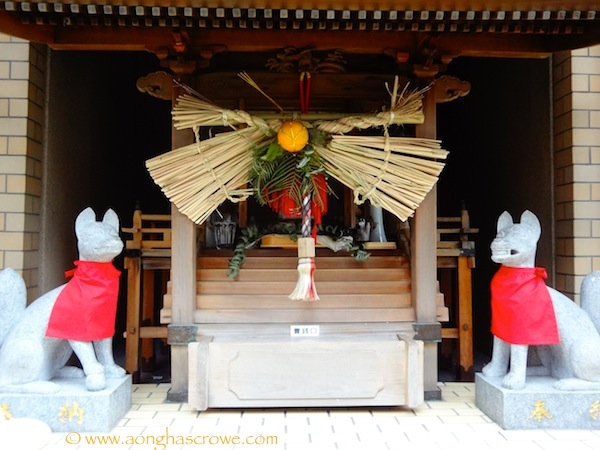
Shiménawa (七五三縄, 注連縄 or 標縄, literally "enclosing rope") are another common decoration of the Japanese New Year. Rice straw is braided together to form a rope, that is then adorned with pine, fern fronds, more straw and mandarine oranges. They can represent a variety of auspicious items, such as the rising sun over Mt. Fuji or a crane. The shiménawa pictured above is the one that hung on my front door a few years ago.

Used mostly for ritual purification in the Shintô religion, shimenawa can vary in diameter from a few centimetres to several metres, and are often seen festooned with shidé paper. The space bound by shimenawa often indicates a sacred or pure space, such as that of a Shintō shrine.

 Shiménawa are believed to act as a ward against evil spirits and are also set up at a ground-breaking ceremonies before construction begins on a new building. They are often found at Shintō shrines, torii gates, and other sacred landmarks.

They are also tied around objects capable of attracting spirits or inhabited by spirits, called yorishiro. These include trees, in which case the inhabiting spirits are called kodama, and cutting down these trees is thought to bring misfortune. In cases of stones, the stones are known as iwakura.

Most of the following photos were taken of shiménawa hanging at the entrance of restaurants and boutiques in my neighborhood.

IMG_4864.JPG
DSC04999.JPG
IMG_4862.JPG
IMG_4863.JPG
IMG_4875.JPG
IMG_4873.JPG
This is the kind of shimékazari typically found in Fukuoka.

This is the kind of shimékazari typically found in Fukuoka.

DSC04994.jpg
In Japanese Customs, Life in Japan, Religion Tags Japanese New Year, o-Shogatsu, お正月, Shimenawa
Comment
Mochitsuki.image.jpeg

Mochi-tsuki

December 29, 2018

Because my sons’ kindergarten is Buddhist, there are no Christmas decorations or Christmas-related events. None whatsoever.

(No worries there as we already do plenty at home.)

The kindergarten does, however, hold New Year’s related events, such as “mochi-tsuki”. 

What’s “moji-zugi”, you ask?

Mochi-tsuki (moh-chee-tsoo-kee) is the making of mochi (rice cake) by pounding steamed sticky rice (もち米, mochi kome) with large wooden hammers for God knows how long. It is in the words of the esteemed Mr. Wiki very “labor intensive”. I think the only thing that we have remotely similar to mochi-tsuki in the US is handmade ice cream.

Now the thing with handmade ice cream is that your effort is rewarded with something that tastes pretty damn good. Mochi, on the other hand, is rather bland. Mixed with sweet beans or covered with syrup, it can be rather nice. But, again, alone it’s so hopelessly boring, it makes you wonder why people go to all the trouble.

My son has already left for school. He asked me to go, too, but as only the fathers of third-year students can attend—damn—I have been spared the forced labor demanded of tradition.

This evening I will be taking my boys to see the Christmas lights in Kego Park and ride the kiddie “Polar Express” train.

There are only five more days till Christmas. For some reason or another, this holiday season has just whizzed by. Last year, I couldn’t wait for it to be over. This year, though, . . .

I think it’s the realization that Christmas with young boys who believe all the stories of Santa Claus, no matter how far-fetched or contradictory, won’t last forever. We’ve got perhaps five or six more years of the season’s magic. And then? Well, we will just have to find a new way to enjoy the holiday. Perhaps with a mochi-tsuki party.

In Japanese Customs, Life in Japan, Religion Tags mochitsuki, mochi-tsuki, 餅つき, New Year's in Japan, Christmas in Japan, Buddhism
Comment
Shime+Kazari+IMG_0238+2.jpg

Shimekazari

December 29, 2018

When you live as long as I have in only one part of a country, it's easy to assume that the way things are done in your region are the same nationwide. It took me two decades to realize that sansha mairi (visiting three shrines at New Year's) was a custom peculiar Kyūshū, and in particular to Fukuoka. 

Similarly, the shimé kazari, a New Year's decoration placed above the entrance to homes and buildings, varies from region to region. Shime-kazari is said to originate from shime-nawa (twisted hemp and rice straw rope placed at the entrance of shrines to indicated a sacred space) and meant to keep misfortune and unclean spirits away and greet Toshigami (年神), the gods and ancestors brought with the new year.

IMG_4867.JPG
DSC05008.JPG
In Japanese Customs, Life in Japan Tags Shimekazari, しめ飾り, 注連飾り, New Year's in Japan, o-Shogatsu, Toshigami
Mochu Silly.JPG

Sorry, but . . .

December 28, 2018

Few end-of-the-year customs in Japan seem sillier to the casual observer than that of the mochū hagaki  (喪中葉書, "mourning postcard"). Mochū hagaki  (pictured above) are postcards sent out to friends, relatives, co-workers, and others in December or earlier, notifying them that due to the death of family member in the past year they are in mourning and will therefore be unable to send nengajō (年賀状), or New Year's greeting cards. It is as if people are saying, "FYI: I am sending this postcard to you now to inform you that I cannot send you that other postcard later."

To be fair, mochū hagaki do serve some useful purposes. For one, they inform others that they need not bother sending a nengajō to the family out of respect for their loss—even when the person who has died was 105 years old, as is the case in the postcard on the left, and "relief" rather than “sorrow” might be a better adjective describing the emotions felt when Great Grandpa finally kicked the bucket. And, probably more importantly, mochū hagaki preemptively assuage any misunderstandings that might occur when a nengajō goes unanswered.

In Life in Japan, Japanese Customs Tags nengajō, New Year's in Japan, o-Shogatsu, お正月, 喪中ハガキ, Mochu Hagaki
Comment
Beaty+Looking+29.jpg

Beauty, Looking Back

December 1, 2018

Several years ago, a friend of mine expressed his admiration of the Japanese language: “They even have a word for a woman who looks beautiful from behind, but when she turns around is actually ugly.”

The word he was referring to was mikaeri-bijin (見返り美人). The phrase originally comes from the ukiyoe woodblock print “Beauty Looking Back” by Hishikawa Moronobu (1618-1694). If I am not mistaken, the phrase didn’t originally contain the connotation of being disappointed once able to look squarely at a woman as it does now.

Even after studying Japanese for over two decades, I continue to be fascinated by the language. Just this morning, when I was looking up “fall from grace”, I came upon a kanji I had never seen before: 寵 (chō).

“Fall from grace” in Japanese, by the way, is kami no onchō-o ushinau (神の恩寵を失う). Bet you won’t be using that phrase anytime soon.

The on (恩) in onchō (恩寵) is a fairly common kanji meaning “obligation, indebtedness, a debt of gratitude”. An “ungrateful” person is someone who literally “doesn’t know the debt of gratitude”: on-o shirazu (恩を知らず).

Chō (寵), on the other hand, doesn’t quite translate neatly into English. It can mean “being particularly loved or doted upon”, “blessed or favored” and so on.

Words containing (寵), include:

            寵愛 (chōai), the favor of (a king)

            寵姫 (chōki), the most loved woman of the monarch

                        This is a word I use daily, as is the next one.

            寵妾 (chōshō), the favorite concubine.

            寵児 (chōji), a darling or star (of the media or literary world)

                        Ah to be a bundan no chōji (分団の寵児)!

            寵臣 (chōshin), the favorite vassal or retainer of the lord


The funny thing about my friend, his initial interest in the Japanese language never developed beyond a handful of expressions, which begs the question: why is it that so many otherwise intelligent and thoughtful Westerners who have lived years, if not decades, in Japan still suck at the language?

In Japanese Language, Life in Japan Tags Mikaeri Bijin, 見返り美人, Studying Japanese
Comment
Nii.1.jpg

Labor Thanksgiving Day

November 23, 2018

About this time every year, I have the same conversation with my students: “There’ll be a national holiday next week,” I begin. “Can any of you tell me the name of that holiday?”

Silence.

“C’mon, think. This Friday — and no peeking at Wikipedia!”

One of the student calls out: “Culture Day!”

“No. Culture Day, or Bunka no Hi, was three weeks ago on Nov. 3,” I remind them. “Thursday, Nov. 23. What’s the holiday? Anyone? Anyone?” I feel like the economics teacher in Ferris Bueller’s Day Off.

“Oh! I know!”

“Ayano, yes, what was it?”

“Kinrō Kansha no Hi.”

“That’s right! Now what is Labor Thanksgiving Day? Anyone?”

One student suggests that it is a day we give thanks to our parents for working hard.

“Well, maybe, but there’s more to it than that. Are any of you doing anything special for Labor Thanksgiving Day?”

Crickets.

I go around the room, asking students what their plans are. Some will work at their part-time jobs, others will probably loaf about at home. A few may go shopping.

“If you’re not going to do anything special, why have a national holiday?” I ask. “Whenever a national holiday holiday rolls around, I always try at least to wear my ‘Rising Sun’ skivvies.”

When half of them laughs, the other half that has been dozing comes to life. Now that I’ve got their attention I ask why some of their holidays, such as the autumnal equinox, Shūbun no Hi, fell on a Saturday last year? “Why not move the day to a Monday like so many other holidays? Why is the date for Shūbun no Hi and other holidays like Kinrō Kansha no Hi fixed?”

They don’t know.

Shūbun no Hi, I explain, is actually one of two Kœreisai and Labor Thanksgiving Day is in reality a harvest festival called Niiname-sai, a Shintō rite performed by the Emperor.

“Have any of you heard of either Kōreisai or Niiname-sai?”

Of course, none have.

“Are you guys really Japanese?” I ask with feigned disbelief, eliciting embarrassed laughter from the students.

I then ask them how many national holidays Japan has.

“Eleven!”

“Nope.”

“Twenty!”

“I wish!”

“Eight!”

“Sorry.”

“Sixteen!”

“That’s right. There are 16 national holidays. And next year there will be nineteen. Many more than most countries have.”

With their help, I write the names of the holidays on the board with the corresponding dates. Once I have them all down, I tell them to pay attention to the 10 holidays that have fixed dates: National Foundation Day (Feb. 11), Showa Day (Apr. 29), Culture Day (Nov. 3) and so on. “Now, what do these days have in common?”

More silence.

“Anyone? Anyone?”

No one even volunteers a guess. They really have no idea what I’m getting at. None.

“All of the holidays with fixed dates are related to the emperor,” I explain. “Ten of your 16 national holidays are related to the emperor.”

You’d think they would know this already, but for the vast majority of them it is a revelation.

  1. New Year’s Day (Jan. 1) was, until 1947, a national holiday on which the imperial worship ceremony called Shihōhai (四方拝) was held.

  2. Foundation Day (Feb. 11) was known as Kigensetsu (紀元節), or Empire Day, until 1947, a holiday commemorating the day on which, legend has it, Emperor Jimmu acceded the throne in 660 BCE.

  3. Vernal Equinox (Mar. 20 or 21), an imperial ancestor worship festival called Shunki Koreisai (春季皇霊祭).

  4. Showa Day, the birthday of Hirohito who has been referred to by his posthumous name Emperor Showa (昭和天皇, Shōwa Tennō) since his death in 1989.

  5. Greenery Day (May 4). This is the former name for Hirohito’s posthumous birthday. In 2007, Greenery Day was moved to May 4 and April 29 was renamed Showa Day. From 1985 to 2006, May 4 was a generic “national day of rest,” one more day expanding Golden Week.

  6. Autumnal Equinox (Sep. 23 or 22). Like the spring equinox, this was an imperial ancestor worship festival called Shuki Kōreisai (秋季皇霊祭).

  7. Culture Day (Nov.3). While this day commemorates the 1946 announcement of the new Constitution, it is actually Emperor Meiji’s birthday. The timing of that announcement was probably not a coincidence. Kenpō Kinenbi, or Constitution Memorial Day, takes place on May 3 and celebrates the promulgation of the 1947 Constitution of Japan.

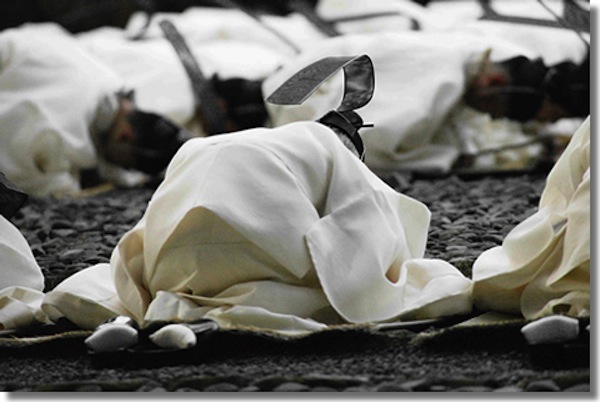
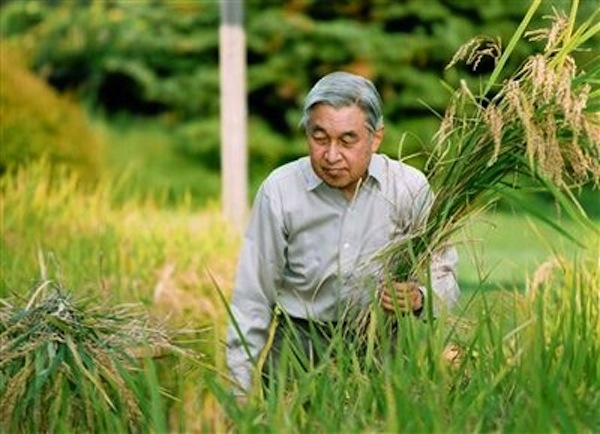
  8. Labor Thanksgiving Day (Nov. 23), again, is the imperial harvest festival called niiname sai (新嘗祭). Niiname-sai (新嘗祭, also pronounced Jinjōsai — lit. Celebration of First Taste) is a Shinto harvest festival that takes place at the Imperial Palace and shrines throughout the country on the 23rd and 24th of November.
    According to the Encyclopedia of Shinto, “The Emperor arranges an offering of sake, rice porridge, and steamed rice (made from the newly harvested rice) served in special vessels crafted from woven beech leaves (kashiwa) and presented to the kami (gods) on a special reed mat (kegomo). Following this evening meal (yumike), the Emperor purifies himself in seclusion (kessai) for the night and, after changing robes (koromogae), prepares the morning offering of food for the kami.”
    The rite is called Daijōsai (大嘗祭) when the emperor performs it for the first time after ascending the throne.

  9. The present Emperor’s Birthday is Dec. 23, or Tennō Tanjōbi. With the abdication of Emperor Akihito and the enthronement of his son, Crown Prince Naruhito, next spring, I suspect that Dec. 23 will be renamed Heisei no Hi once Feb. 23 becomes the new Tennō Tanjōbi, bringing the number of national holidays to 17, and those related to the Emperor to 11. (Actually, there will be even more holidays due to the ceremonies related to the abdication and enthronement.)

As for the 10th, Marine Day (the third Monday of July), this holiday used to be held on July 20 and commemorated Emperor Meiji’s return to Yokohama at the end of a trip around the Tōhoku region of Japan aboard the sailing ship, Meiji Maru. (Incidentally, the restored ship is on display at the Etchujima Campus of the Tokyo University of Marine Science and Technology.)

“Why do you know this?” a student asks me.

“Why don’t you?” I shoot back.

“We’re not interested… ”

“This has nothing to do with being interested or not. I’m not all that interested in Japanese holidays myself, but I am curious.”

“Curious?”

“Yes, curious! You have a national holiday called Marine Day. Didn’t that ever make you wonder why there wasn’t a Mountain Day, too? Well, I guess there is now, so go figure. Or, doesn’t it strike you as odd that you have all these national holidays on which you don’t do anything in particular? Again, why have a national holiday? Case in point, the equinoxes: why are they national holidays, but Obon (Japanese festival of the dead) is not? Obon is a much more important holiday for ordinary Japanese people, but it’s not a holiday . . .”

Curiosity. Inquisitiveness. A healthy dose of skepticism. These are things that are sorely lacking among Japanese students today.

Nii.5.JPG
Nii.8.jpg
Nii.6.jpg
Nii.4.jpg
Nii.7.JPG
Nii.2.jpg
Nii.3.jpg

Established in 1948, Labor Thanksgiving Day is a day on which, we are told, Japanese “celebrate production and give thanks to their fellow citizens”. In reality, they do little more than blow both the day and their hard-earned money mesmerized by pachinko machines.

In Japanese Language, Life in Japan, Religion Tags Labor Thanksgiving Day, 勤労感謝の日, 新嘗祭, Niinamesai, Japanese Emperor, Shinto, Shintoism, 神道, Way of the Gods, Japanese National Holidays
Comment
Sumo+IMG_4664.jpg

A Years Worth

November 16, 2018

The Kyūshū Basho, Sumō’s sixth and final tournament of the year, was held last month in Fukuoka. 

Although I rarely watch Sumō today, there was a time when I was very much into the sport. Until around the late nineties, I followed the sport closely, almost never missing an episode of “ŌzumōDigest”, a program which aired each night during the fifteen days of the tournaments and recapped the day’s highlights. Quite a few dates were cut short, I recall, so that I could hurry home and catch the results of the day’s bouts.

I must admit, though, that sumō is a pretty boring, especially if you have to watch an entire day of salt-throwing and menacing poses. But back in the nineties, the rivalry between the crown princes of sumō--the Hanada brothers, Takanohana and Wakanohana--and three upstarts from Hawaiians--Konishiki, Akebono, and Musashimaru--made the sport more dramatic than it ever has been. Since the retirement of those wrestlers the popularity of sumō has been pushed out of the TV ring, in a sense: “Ōzumō Digest” stopped being broadcast in 2003.

Anyways, one of the things that I have always wondered about sumō was the prizes given to the winning rikishi (wrestler) on the final day of the tournament. 

In addition to a nice stack of cash (no cheques in this country) and a huge trophy, the winner is often given a number of “supplementary prizes” from a variety of sponsors. Most of these prizes come in the form of a “year’s supply of this” or a “year’s supply of that”. For example, a year’s supply of rice, beer, saké, toiletpaper--yes, toiletpaper--miso paste, gasoline, and so on.

According to the Japan Sumō Association (日本相撲協会), the amounts offered are defined by the sponsor. Ōzeki, maker of the poor-man’s saké, One Cup Ōzeki, provides the winning wrestler with 360x 180ml bottles of their fine saké.

As for rice, Zennō (全国農民組合, National Union of Farmers) gives the winner thirty tawara (俵) of rice, where one tawara is equivalent to about 60kg of rice. The average Japanese, since you’re itching to know, consumes about 70kg of rice. It takes about 78kg of unpolished, brown rice (玄米, genmai) to produce 70kg of polished white rice, or the stuff you usually find in your rice bowl. A 10 “are” (1000m2) rice field, incidentally, produces about 500kg of genmai. To produce enough rice for the average Japanese consumer, you’d need to have a rice field that was 150m2 (or 45 tsubo), about half the size of a tennis court. (For more on this go here.) The winning sumō champ, of course, is not expected to eat all 1,800kg of rice; he shares it with his "stablemates".

Miyazaki prefecture has also been known to award the champion rikishi with a year’s supply of beef. In actuality, this is amounts to one head of cattle (just the head, my rancher uncle often jokes) as well as a ton (1000kg) of veggies.

Itadaki—burp—masu!

Sumo+IMG_4627.jpg
Sumo+IMG_4621.jpg
Sumo+IMG_4543.jpg
Sumo+IMG_4551.jpg
In Food, Life in Japan Tags Sumo, Kyushu Basho, 大相撲, Sumo Prizes
Comment
School Lunch IMG_8962.JPG

School Lunch in Japan

November 16, 2018

My wife visited our son's elementary school today to attend a lecture about kyūshoku, or school lunch. The presentation ended up being more interesting than she had expected.

In Fukuoka City, there are 144 elementary schools (grades 1-6) with a total of 80,077 students. The schools are divided into five blocks to prevent shortages in ingredients as almost all of them are sourced locally from within the prefecture.

To my surprise, each school has its own kitchen and a staff of up to 8, including licensed nutritionists. (I had been under the impression that a central kitchen was being used.) Vegetables are hand washed and hand cut. Although most dishes are made from scratch, some of the items, such as today's paozi(steamed dumplings), are prepared in advance by third party producers.

The lunches, as I have noted before, include many international dishes as a way of introducing kids to other cultures ahead of the 2020 Tokyo Olympics and World Swimming Championship that are going to be held in Fukuoka.

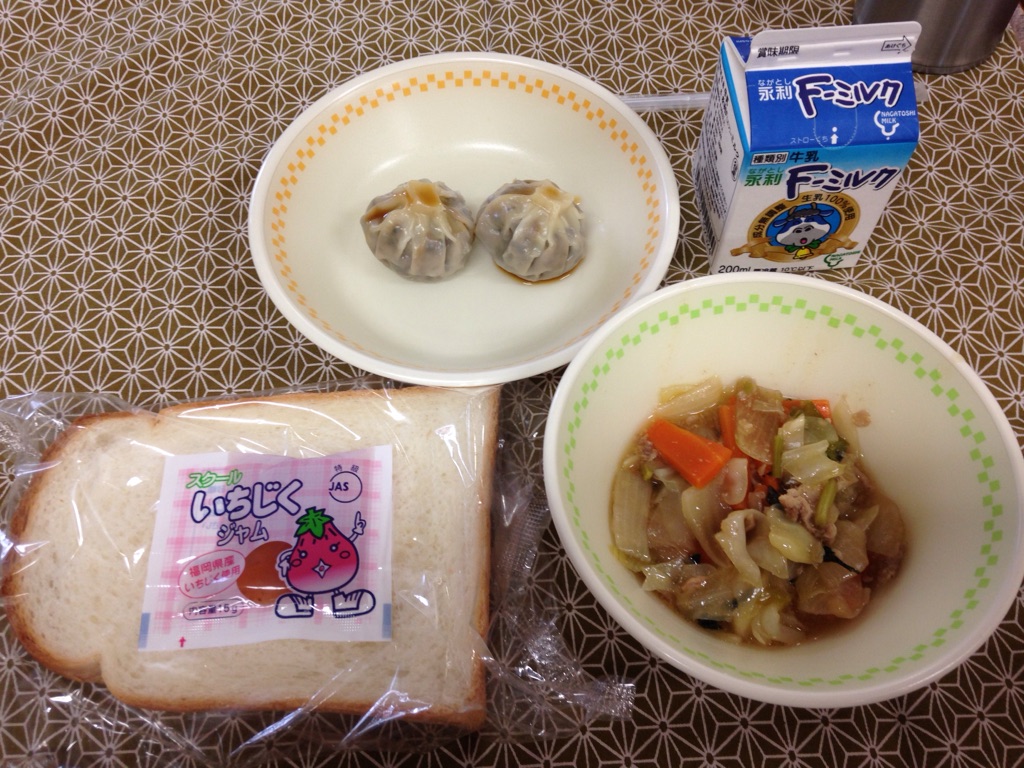
Today's lunch included a Chinese style stir-fry, paozi dumplings, bread with locally grown fig jam, and milk.

Each meal costs on average ¥243 ($2.23) and contains about 530 calories. Meals for junior high kids contain 640 calories; those for high schoolers, 740.

And, no, the food is not gluten-free and may contain lethal quantities of peanuts.

Thai-style Gapao Rice and Japanese-style White Stew

Thai-style Gapao Rice and Japanese-style White Stew

Pork and Beans, Raisin Bread, and Cabbage/Kelp Stir Fry

Pork and Beans, Raisin Bread, and Cabbage/Kelp Stir Fry

Fish flavored with Sesame, Miso Soup, and Rice

Fish flavored with Sesame, Miso Soup, and Rice

In Education, Food, Life in Japan Tags School Lunch, Kyushoku, Japanese Elementary School, 給食, Japanese Education, Japanese Cuisine
DSC04577.jpg

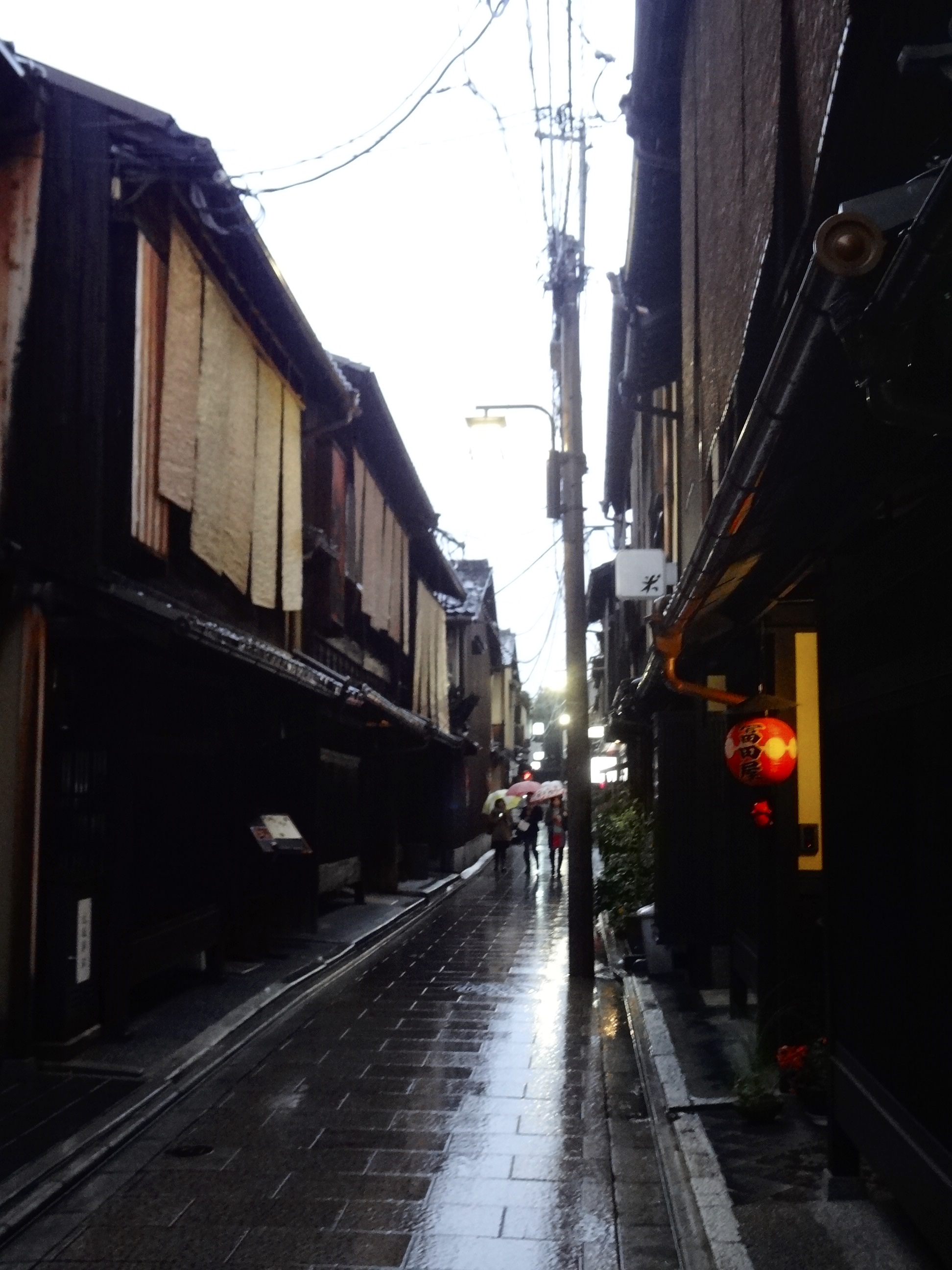
Kyoto in 2012

November 8, 2018

Looking at photos of Kyoto from a visit I made in 2012 and I can't believe how empty the streets are. Three years later the "Bakugai Tourists" from China would descend upon this and other sleepy towns in Japan, hold a steel wash tub over their heads and start banging away.

DSC04579.jpg
DSC04587.jpg
IMG_4293.jpg
IMG_4298.jpg
DSC04576_2.jpg
DSC04581.jpg
In Life in Japan, Travel, Trends in Japan Tags Tourism in Japan, Chinese Tourists, Kyoto, Bakugai, 爆買い
Comment
Childhood+Poverty+Rates+by+Prefecture.png

Childhood Poverty in Japan

November 7, 2018

There has been much handwringing of late with regard to the childhood poverty rate in Japan. This is something I would like to address in future posts, but for now I want to share a graph I found which shows childhood poverty rates by prefecture.

Overall, Japan has a childhood poverty rate of 13.8%, considerably less than America's rate of 21%. But looking at individual prefectures, we find that the poverty rate of Okinawa, the nation's worst, is 37.5%. Ōsaka has the second highest childhood poverty rate at over 20%. Kagoshima is third and my prefecture of Fukuoka is fourth with just under 20%, meaning one in five kids is living in poverty. Sobering statistics, to say the least.

For some albeit dated perspective, here is how Japan compares to other countries in the OECD. On average, 13.4% of children in OECD countries live in “relative income poverty”, which is defined “as the percentage of children (0-17 year-olds) with an equivalised household disposable income (i.e. an income after taxes and transfers adjusted for household size) below the poverty threshold. The poverty threshold is set here at 50% of the median disposable income in each country.”

https---blogs-images.forbes.com-niallmccarthy-files-2016-01-20160104_Child_Poverty_Fo_02.jpg
In Economy, Life in Japan Tags Childhood Poverty in Japan, Childhood Poverty, Poverty, OECD Childhood Poverty Rates
Comment
jie+de+vivre_3642.JPG

Joie de Vivre in Hong Kong

October 23, 2018

Donald Richie in one of his collections of essays wrote about how the "narrowness" of the Japanese home forced people to seek places to relax elsewhere--a favorite snack or kissaten (coffee shop). These, he wrote, were extensions of their home.

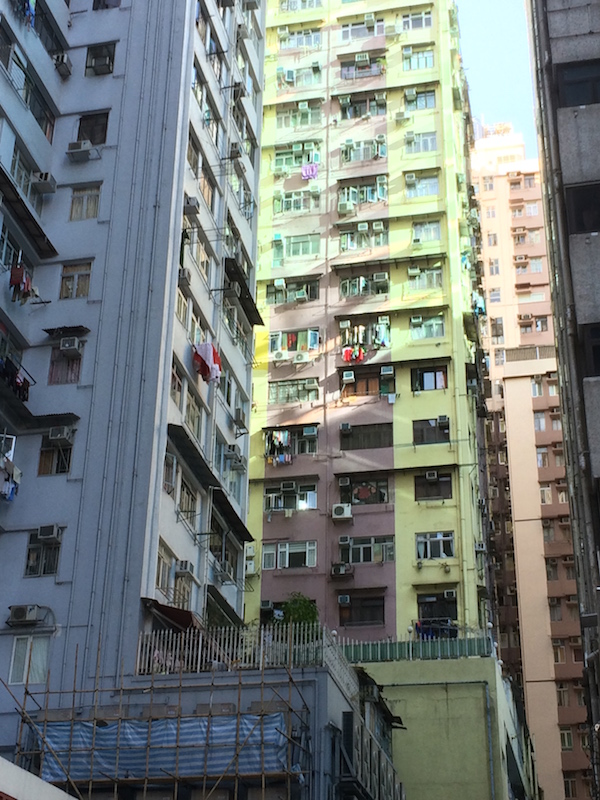
I'm sure I have misparaphrased that, but I couldn't help thinking about what the Japanologist had written while I was wandering the streets of Hong Kong. Streets were like dry riverbeds between deep ravines, the walls of which were formed by impossibly tall, impossibly slim apartment buildings. 

Google "small Hong Kong apartment" and you'll find photos of insane living conditions; apartments no bigger a four-mat room in a Japanese home.

Decades ago, a girlfriend of mine went to Hong Kong to help her friend with her flower buisness. "They slept on the kitchen floor!" she told me when she returned. I couldn't quite picture people living in conditions so cramped, but now that I've been to the city, I can.

Richie wrote of the uncomfortably cramped living conditions of modern Japanese, but in reality it isn't all that bad. My 90-square-meter, 4LD here in Fukuoka would probably house three to four middle class families in Hong Kong. Perhaps more. 

Another thing, you can see further than fifty meters here in Fukuoka. Visitors to Japan from HK must feel liberated being able to just breathe the air while they're here.

jie+de+vivre_3635.JPG
jie+de+vivre_3654.jpg
jie+de+vivre_3569.jpg
jie+de+vivre_3657.jpg
In Japanese Architecture, Life in Japan Tags Hong Kong, joie de vivre, Donald Richie, Cramped Housing
Comment
Common Cold.jpg

Feeling Negi-lected

October 18, 2018

“Go to the doctor’s,” she says.

“I’d rather just stay in bed and sleep.”

“No, you have to go,” she insists. “Besides, it’s much cheaper to see the doctor than buy over-the-counter drugs.”

“Okay, okay.” She has a point. So I crawl out of the futon, shower, then stagger in muted delirium to my doctor’s clinic.

Because it’s a Saturday, the clinic is somewhat busier than usual. Several men are having their physicals. Two women in the waiting room look as sick as I feel. After about fifteen minutes, I’m summoned to the doctor’s room. When I tell her what my symptoms are—achy body, high fever, headache, fatigue—she recommends the old tickle the brain with a twig up nostril. What can I do but submit? But then the test turns out negative meaning I was tortured for the nurse’s kicks alone. Another chat with my doctor; we decide which meds I want; and then I return to the waiting room until the receptionist can ring me up. (This being Japan, of course, it comes to only $15.)

Checking my watch, I see I haven’t got enough time to pick up the meds from the pharmacy downstairs before work starts, so I head home instead.

Once home I ask my wife if she can pick up the meds for me.

“Sure.”

“Fantastic. I appreciate it.”

An hour later, I ask if she got the meds.

“I can’t go out with my face looking like this.”

Ugh.

Another 90 minutes later, I ask again if she picked up my medicine.

“Not yet.”

Four hours later, my wife returns.

“Got the meds,” I asked.

“No. All the pharmacies were closed.”

Argh! Why the hell did you insist upon my going to the doctor’s then?!?! 

So, another night of mediocre, lightweight drugstore pills for me. Maybe some negi (green onions) will do the trick?

In Life in Japan, Married Life Tags ネギ, Green Onions for Colds, Sore Throat, Visiting a Doctor in Japan, Health Insurance in Japan
Comment
Last+Summer+at+the+Beach+01.jpg

The Frenchman at the Beach

September 24, 2018

A recent op-ed piece about the sorry lot of foreign men "trapped" in Japan reminded me of the following story:

A few years back, I met a French guy at the beach. An architect living and working in Tokyo, he was passing through Fukuoka on his way to Kagoshima. He asked if I minded sitting down and talking with him. Not at all, I said.

You seem to have made it, he said.

He was referring to my family who was with me at the beach that day. I suppose we looked like a happy, carefree family, the four of us playing in the sand.

“What’s the secret,” he asked.

“Time,” I replied. “I’ve been here for over twenty years and have been through more rough patches than I can count—financial ups and downs, problems at work, frustrations and heartbreak, to name a few.”

The Frenchman explained that he had recently been dumped. Happened right out of the blue. One day they were living together, just as happy as a couple could be, and the next day she vanished. Poof!

“That happened to me about three times,” I told him.

He looked like he was about to start crying.

“Let me buy you a beer,” I said, getting up.

When I returned with the beer, I had the following advice: “One, you’re lucky you found a sympathetic ear today because I’ve been there myself. You probably won’t be so lucky next time, so do what you’ve already told yourself to do.” He had scrawled SHUT UP! on the inside of his forearms. “Two, start fucking. Put some bodies between you and the girl and, trust me, you’ll start feeling better. Three, focus on your career, pour yourself into you work. And, four, be patient, because nothing heals like time.”

Cheers, we said, clinking our beer bottles together.

In Life in Japan, Married Life Tags Living in Japan, Heartbreak, Kagoshima, Beach
Comment
IMG_2073.jpg

Kyoto Tower

September 10, 2018

I stood in front of the Hotel Granvia for about a half an hour, and as I waited for you I couldn’t help wondering what on earth “Granvia” was supposed to mean.

Was it a reference to Madrid’s Gran Via, literally “Great Way”, the so-called “Broadway of Spain”, the street that never sleeps? And if so, what did that have to do with muted Kyōto, a city where many restaurants close as early as nine in the evening? Or was it in some way an allusion to the “Great Vehicle” of Mahāyāna Buddhism. Probably not. Most likely, the owners just liked the “sound” of it.

These silly, often meaningless names that architects and planners insisted on slapping on buildings, even here in Kyōto, the very heart of Japan, often made me wonder if the Japanese hated their own culture and language.

Unfortunately, the folly wasn’t limited to naming. Infinitely worse, it expressed itself in monstruments like the awful Kyōto Tower that stood across the street from me like a massive cocktail pick. A fitting design, because the people who had the bright idea of creating it must have been drunk.

The bombings of WWII, which reduced most Japanese cities to ashes, spared Kyōto for the most part, meaning the ancient capital is one of the few cities in Japan with a large number of buildings predating the war. Or shall I say, was. Because that which managed to survive the war proved no match for wrecking balls, hydraulic excavators, and bulldozers.


The first chapter of Tears can be found here.

This and other works are, or will be, available in e-book form and paperback at Amazon.

In Japanese History, Life in Japan, Japanese Architecture Tags Kyoto Tower, Hotel Granvia, Urban Planning in Japan, WWII Bombing of Japan, Kyoto in WWII
Comment
img_0.jpeg

Beware of Uncle Pervie

September 5, 2018

Every few days we get an email from the local elementary school reporting a "fushin-na jinbutsu" (不審な人物, suspicious person).


My first thought when reading these mails is usually "Geez, I hope someone isn't reporting me." Because of my running routine--I run like a burglar through about four different school districts dressed in BRIGHT pylon orange almost every morning--and the fact that I am a "guyjin", I stand out. There are often reports of my being seen running here or there.


The second thought is often "Geez, these perverts have not improved upon their game one iota in the four decades since I was a kid.”


Just the other day, a "young man" walked up to an elementary school girl and said, "Your father's been in an accident. Come with me and I'll take you to the hospital."


Oldest trick in the Perv Book!


The girl had the good sense to ask the man what her father's name was. When he couldn't answer, she ran away.


Today, a boy was approached by someone who promised to give him "something nice" if he came with him.


Second oldest trick!


Fortunately, this young boy also had the good sense to high-tail it.


In Life in Fukuoka, Life in Japan, Raising Kids in Japan Tags Chikan, Perverts, 痴漢
Comment
← Newer Posts Older Posts →

Latest Posts

Subscribe

Sign up with your email address to receive news and updates.

We respect your privacy.

Thank you!
Blog RSS

Blog

Featured
533578549_779743457907505_9184140746382917063_n.jpg
Aug 19, 2025
Fighting in the Pacific Theater Post August 15
Aug 19, 2025
Aug 19, 2025
que-12241102027.jpg
Mar 26, 2025
 Meiji Modernization and German Influence
Mar 26, 2025
Mar 26, 2025
Screenshot 2025-02-04 at 6.21.14.png
Feb 4, 2025
Risshi-Shiki
Feb 4, 2025
Feb 4, 2025
政党の変遷_20181001.jpg
Nov 3, 2024
Japan's Political Parties
Nov 3, 2024
Nov 3, 2024
EB9D8A29-A874-400F-9D59-619E85CFD8C5.png
Sep 9, 2024
Keio JR High School’s Entrance Exam
Sep 9, 2024
Sep 9, 2024
Sinburyou.jpg
Mar 25, 2024
Shinburyo
Mar 25, 2024
Mar 25, 2024
GH1mAHXXUAAaJgc.png
Mar 18, 2024
Survival Japanese
Mar 18, 2024
Mar 18, 2024
Usui.jpg
Feb 20, 2024
Usui
Feb 20, 2024
Feb 20, 2024
images.png
Feb 16, 2024
Blue Bottle
Feb 16, 2024
Feb 16, 2024
Screenshot 2024-02-13 at 8.32.52.png
Feb 13, 2024
Private Schools
Feb 13, 2024
Feb 13, 2024

INSTAGRAM

View fullsize All ready for Thanksgiving.

#shochu #imojochu #焼酎 #いも焼酎
View fullsize Display Cases of Kyoto
View fullsize Inuyarai in Kyōto 

京都の犬矢来

Found under the eaves of townhouses (machiya) in Kyoto and along the road, inuyarai were originally made of split bamboo. In modern times, however, they are sometimes made of metal. The original purpose of the arched barri
View fullsize Walls in Gokusho Machi, Hakata
View fullsize The 15th of August is the last day of the Bon Festival of the Dead, Japan’s version of Dia de muertos. On this day, Japanese say goodbye to the spirits of their ancestors. Today I say goodbye to my last drop of Yamato Zakura Beni Imo 35%. Forgi
View fullsize Azaleas at Fukuoka’s Kushida Shrine 

#櫛田神社 #Kushida #springinjapan #Fukuoka
View fullsize Mugon (Tacit, lit. Without Words) rice shōchū genshu from Sengetsu Distillery of Hitoyoshi, Kumamoto. Aged in cypress casks, I believe, it retains that telltale hinoki scent. I normally don’t drink Kuma-jōchū, but this is lovely. I’ll buy
View fullsize Another one of my somewhat hard-to-find favorites. Sang Som from Thailand. So smooth. I used to keep a bottle of it at Gamaradi before the pandemic. May have to do so again. Missed it. Missed Mr. Chang.
View fullsize First drink of the New Year is the best find of the past year: 

Yaesen Shuzō genshu #awamori from #Ishigaki Island. Aged in oak barrels, it has the nose of whiskey, the mellow sweet taste of a dark rum. At ¥5000 a bottle, it’s rather price
View fullsize Santa arrived early and just in time for Labor Thanksgiving Day 🇯🇵 

Two bottles of imo shōchū—one is a favorite, the other an interesting find I happened across during a short visit last summer to the Koshiki archipelago off the western coas
View fullsize Mission accomplished!

Dropped by the new Flugen in Hakata to drink one of my all-time favorite spirits, the somewhat hard-to-fine-but-worth-the-search Linie Aquavit from Norway.

#Flugen #Aquavit #Hakata
View fullsize Two or three weeks ago a friend invited me to join him at a big shōchū and awamori wingding at #FukuokaDome. Ended up buying about ten bottles of booze which I have stashed away at the in-laws’ for safekeeping. Of all the things I bought, this
View fullsize Takumi has once again included Maō in one of their #shochu box sets. At ¥5550, it’s not a bad deal. 

Kannokawa genshū—another favorite of mine made with anno sweet potates from Tanegashima—sold me. Ended up buying two. 

#かんぱい
View fullsize A little present to myself to mark the midpoint of the semester. Easy coasting from here.

Cheers and kampai!

#いも焼酎 #imoshochu #shochu #大和桜 #YamatoZakura
View fullsize Naha, Okinawa

#マンホール #Manhole #Naha #Okinawa #shisa #シーシャ
View fullsize At American Village in Chatan, Okinawa.

#北谷 #マンホール #沖縄 #Manhole #Chatan #Okinawa
View fullsize Final bout lasted 8 seconds. So, I guess it’s safe to say we’ve got that fickle momentum back.

#Karate #空手 🥋 #Kumite #組手
View fullsize 京都ぶらぶら

A long, slow walk through Kyōto
View fullsize 京都ぶらぶら

Kyōto stroll
View fullsize Always good to visit with my fellow traveler.

Gourmets of the world unite!
IMG_3919.jpg

KAMPAI Blog

Featured
Screenshot 2024-02-07 at 17.39.19.png
Feb 7, 2024
60 : 35 : 5
Feb 7, 2024
Feb 7, 2024
1614050579_3.jpg
May 15, 2023
Satsuma Imo Motogusare Disease
May 15, 2023
May 15, 2023
Seifuku Imuge.jpeg
Jun 22, 2021
Seifuku's Imugé
Jun 22, 2021
Jun 22, 2021
May 24, 2021
Kachaashii
May 24, 2021
May 24, 2021
MCHS1968.jpeg
May 16, 2021
Destine
May 16, 2021
May 16, 2021
Apr 26, 2021
Moriawaro
Apr 26, 2021
Apr 26, 2021
Mar 3, 2021
Kampai Shanshan
Mar 3, 2021
Mar 3, 2021
IMG_2395.jpeg
Jan 28, 2021
Mitake Genshu
Jan 28, 2021
Jan 28, 2021
Kikoji.jpeg
Jan 27, 2021
Kokubu Kikoji Kura
Jan 27, 2021
Jan 27, 2021
Hakaio.jpeg
Jan 15, 2021
Hakaio
Jan 15, 2021
Jan 15, 2021
rokuban+wing+2.jpg

Too Close to the Sun

Featured
Feb 20, 2019
80. Why the long face?
Feb 20, 2019
Feb 20, 2019
Feb 20, 2019
79. The Itch
Feb 20, 2019
Feb 20, 2019
Jan 24, 2019
78. Soaring
Jan 24, 2019
Jan 24, 2019
Jan 23, 2019
77. Yaba Daba Doo!
Jan 23, 2019
Jan 23, 2019
Jan 3, 2019
76. Let's Make a Deal
Jan 3, 2019
Jan 3, 2019
Nov 22, 2018
75. The Pied Piper of Patpong
Nov 22, 2018
Nov 22, 2018
Nov 16, 2018
74. Ping Pong Pussy
Nov 16, 2018
Nov 16, 2018
Oct 18, 2018
73. Yaba
Oct 18, 2018
Oct 18, 2018
Oct 16, 2018
72. Lightning Strikes Twice
Oct 16, 2018
Oct 16, 2018
Oct 10, 2018
71. Contacting De Dale
Oct 10, 2018
Oct 10, 2018
A Woman's Tears.jpg

A Woman's Tears

Featured
Apr 2, 2018
18. Just When I Stop Looking
Apr 2, 2018
Apr 2, 2018
Apr 1, 2018
17. Catch and Release
Apr 1, 2018
Apr 1, 2018
Mar 29, 2018
16. Nudging Destiny
Mar 29, 2018
Mar 29, 2018
Mar 25, 2018
15. HAKATA RESTORATION PROJECT
Mar 25, 2018
Mar 25, 2018
Mar 20, 2018
14. Reversible Destiny
Mar 20, 2018
Mar 20, 2018
Mar 12, 2018
13. Graduation
Mar 12, 2018
Mar 12, 2018
Mar 12, 2018
12. Reading Silence Aloud
Mar 12, 2018
Mar 12, 2018
Mar 7, 2018
11. Shut Out
Mar 7, 2018
Mar 7, 2018
Mar 6, 2018
10. The Second Night
Mar 6, 2018
Mar 6, 2018
Feb 28, 2018
9. At the farmhouse
Feb 28, 2018
Feb 28, 2018

Silent Ovation

Featured
Ovation.11.png
Feb 27, 2024
11. High School
Feb 27, 2024
Feb 27, 2024
Screenshot 2024-02-11 at 4.25.37.png
Feb 11, 2024
10. Taichiro Remarries
Feb 11, 2024
Feb 11, 2024
Screenshot 2024-02-05 at 6.24.29.png
Feb 5, 2024
9. Death of My Father
Feb 5, 2024
Feb 5, 2024
hand1.gif

A Woman's Hand

Featured
Jan 24, 2019
52
Jan 24, 2019
Jan 24, 2019
Jan 24, 2019
51
Jan 24, 2019
Jan 24, 2019
Jan 23, 2019
50
Jan 23, 2019
Jan 23, 2019
Jan 3, 2019
49
Jan 3, 2019
Jan 3, 2019
Nov 22, 2018
48
Nov 22, 2018
Nov 22, 2018
unnamed-1.jpg

A Woman’s Nails

Featured
CHHn-rqUIAA4iPq.jpg
Feb 21, 2021
14. Nekko-chan
Feb 21, 2021
Feb 21, 2021
71e7595d28eb0d7d76becf80c766aba2_3.jpg
Feb 20, 2021
13. Tatami
Feb 20, 2021
Feb 20, 2021
Feb 18, 2021
Yoko (Extended Version)
Feb 18, 2021
Feb 18, 2021
197512.jpg
Feb 18, 2021
11. Yoko
Feb 18, 2021
Feb 18, 2021
Feb 17, 2021
10. Yumi
Feb 17, 2021
Feb 17, 2021
00006204.jpg
Feb 16, 2021
9. Mie
Feb 16, 2021
Feb 16, 2021
aonghascrowe-reina-2.jpeg
Feb 11, 2021
8. Reina
Feb 11, 2021
Feb 11, 2021
mie-6.jpg
Feb 10, 2021
7. Mie
Feb 10, 2021
Feb 10, 2021
aonghascrowe-reina-3_4.jpg
Feb 4, 2021
6. Reina
Feb 4, 2021
Feb 4, 2021
abeoto-gravure-image5-52.jpg
Feb 3, 2021
5. Machiko
Feb 3, 2021
Feb 3, 2021
Schechter.Bavel_.TowerofBavel.jpg

HOGEN/Dialect

Featured
Uwabaki.2.jpg
Apr 17, 2024
Uwabaki
Apr 17, 2024
Apr 17, 2024
chinsuko.jpg
Apr 9, 2024
Chinsuko
Apr 9, 2024
Apr 9, 2024
Scan.jpeg
Mar 17, 2024
The Snack with 100 Names
Mar 17, 2024
Mar 17, 2024
Minsa Ori.1.jpg
Feb 26, 2024
Minsa Ori
Feb 26, 2024
Feb 26, 2024
71a4db62b521cf61e57d092101ed1615.jpg
Feb 7, 2024
Taicho ga Warui
Feb 7, 2024
Feb 7, 2024
DTa7CejVoAAGPWU.jpg
Aug 17, 2023
Hashimaki
Aug 17, 2023
Aug 17, 2023
img01.png
Aug 16, 2023
Dialects of Japan
Aug 16, 2023
Aug 16, 2023
town20191010201613_large.jpg
Aug 16, 2023
Yoso vs Tsugu
Aug 16, 2023
Aug 16, 2023
IMG_0831.jpeg
Aug 13, 2021
Uchinaguchi nu Arinkurin
Aug 13, 2021
Aug 13, 2021
Mar 18, 2021
Kampai Shanshan
Mar 18, 2021
Mar 18, 2021
Articles.jpg

Articles

Featured
GPBlog_SummerHomework(GaijinPot_iStock-1024x640.jpg
Aug 27, 2021
With Friends Like These
Aug 27, 2021
Aug 27, 2021
スクリーンショット 2021-06-11 20.22.21.png
Jun 13, 2021
2 Seasons
Jun 13, 2021
Jun 13, 2021
952-LW-illo.jpg
Apr 14, 2019
High Time for Summer Time
Apr 14, 2019
Apr 14, 2019
onomatopoeia.jpg
Jun 18, 2018
Potsu Potsu: Japanese Onomatopoeia and the Rain
Jun 18, 2018
Jun 18, 2018
point-card-lead.jpg
May 19, 2018
Point Break
May 19, 2018
May 19, 2018
last-word-01-860x480.jpg
May 2, 2018
F.O.B. & A-Okay
May 2, 2018
May 2, 2018
Cathay.fukuoka-guide.jpg
Apr 4, 2018
Fukuoka Guide: Spring 2018
Apr 4, 2018
Apr 4, 2018
IMG_4503.jpg
Feb 12, 2018
Woman Kinder-rupted
Feb 12, 2018
Feb 12, 2018
expo_25.jpg
Feb 11, 2018
Summer of Loathing
Feb 11, 2018
Feb 11, 2018
Electtttt-2.jpg
Feb 11, 2018
Election Primer
Feb 11, 2018
Feb 11, 2018

Play With Me

Featured
IMG_0541.jpg
Jan 21, 2018
Jan 21, 2018
Jan 21, 2018
IMG_1318_2.jpg
Jan 21, 2018
Jan 21, 2018
Jan 21, 2018
IMG_1319_2.jpg
Jan 21, 2018
Jan 21, 2018
Jan 21, 2018

Please Write

Featured
IMG_1145_2.jpg
Jan 21, 2018
Jan 21, 2018
Jan 21, 2018
IMG_0862.jpg
Jan 21, 2018
Jan 21, 2018
Jan 21, 2018
IMG_1417.jpg
Jan 21, 2018
Jan 21, 2018
Jan 21, 2018
1000 Awesome Things About Japan

1000 Awesome Things About Japan

Featured
Peas and rice.jpeg
Feb 26, 2020
8. Peas Gohan
Feb 26, 2020
Feb 26, 2020
Finders, Keepers.jpg
Jan 16, 2019
7. Finders, Returners
Jan 16, 2019
Jan 16, 2019
Things+Love+About+Japan.6.1.jpg
Oct 10, 2018
6. No Guns
Oct 10, 2018
Oct 10, 2018
Lockers+IMG_8310.jpg
Oct 10, 2018
5. Coin Lockers
Oct 10, 2018
Oct 10, 2018
IMG_5676.JPG
Sep 11, 2018
4. Sentō
Sep 11, 2018
Sep 11, 2018
manu.jpeg
Sep 10, 2018
3. Uprightness
Sep 10, 2018
Sep 10, 2018
IMG_2220.jpg
Sep 6, 2018
2. Manhole Covers
Sep 6, 2018
Sep 6, 2018
On+Board.jpg
Sep 5, 2018
1. Flying in Japan
Sep 5, 2018
Sep 5, 2018
Featured
2nd Carrier Kido Butai.jpeg
Dec 5, 2021
5 December 1941
Dec 5, 2021
Dec 5, 2021
NYT 1 Dec 1941.png
Dec 1, 2021
1 December 1941
Dec 1, 2021
Dec 1, 2021

Powered by Squarespace